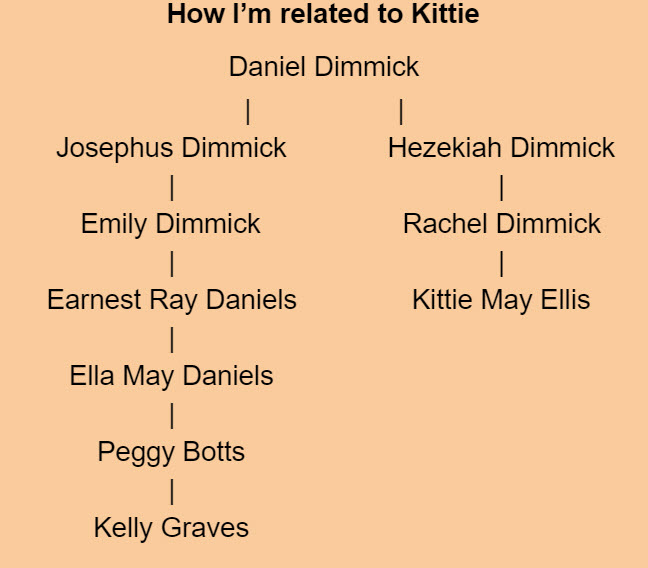
Kittie May Ellis was my first cousin three times removed. She is one of those names on the genealogy chart that I always considered “of no genealogical significance,” meaning she (like myself) never married and had no children and would therefore never have anyone in future generations give her a second thought. She caught my eye after finding some of her journals–written when she was in her late 80s–online and realizing what an amazing, surprising, and puzzling woman she was, particularly given her generation and circumstances. I don’t know her whole story, but what I know is definitely worth telling.
Kittie May Ellis wrote that she was “born in an Iowa Cyclone” in Hardin County, Iowa1 (census records indicate that she was actually born in Nebraska) on September 13, 1869, the second (and last) child of Andrew M. Ellis, a carpenter, and his wife Rachel Ann (Dimmick). The family never settled in one place for long–Andrew and Rachel moved from Iowa (where Kittie’s brother Perry was born) to Nebraska, then Missouri, to Washington state, and finally to Oregon where, by 1900, the family was living on a farm in Washington County.
Although her brother Perry eventually married and had a family, Kittie remained single until her death at age 93 in 1963. She states in her diaries that she “never married for I didn’t want to run the risk of bringing Children into the world to maybe be fiends like my Father2.” The diaries that are readily available do not detail her father’s fiendishness. Nor do they explain the circumstances that left her, and not her older brother, as head of the family, but she explains that prior to her mother’s death from stomach cancer in 1908, arrangements were made to transfer 6-½ acres to Kittie with the condition that she care for her brother and father “as long as they could get along agreeable.”3 They apparently didn’t get along; by the 1910 census, her father had moved out and she was left with her brother and his family.4
Perry had fathered three children when tragedy struck in July 1915, as reported in a La Grande, Oregon newspaper:
Forest Grove, Or., July 5.–The 7 months’ old child of Perry Ellis, a farmer living ten miles northwest of this place, was killed a few days ago when a skantling fell from a barn the father was building and striking the child on the head, causing instant death. There were three children sitting together when the accident occurred, the other two being untouched.5
There is no indication that the death of the child was anything but an accident; however, three days later the coroner arrived to find the baby still in the house and Kittie and Perry distraught, “obsessed with the idea that all neighbors are against them.”6 Following a two-day hearing in which the coroner and neighbors testified to the Ellis’ mental instability,7 both Kittie and Perry were committed to the Oregon State Hospital for psychiatric evaluation. Kittie remained in the hospital for three years before returning to her farm. Perry was never released; he died in the hospital in 1932, and his cremated remains are still held by the State. No one has ever claimed them.
By 1930, Kittie was living alone in Portland and was working as a practical nurse.8 In 1933, at the age of 64, she moved to Clearview, just north of Seattle in Snohomish County, Washington, and began writing her life story, filling over one hundred volumes before her death. The journals are a fascinating mix of current events, political commentary, and autobiography, in which she views the world through newspaper articles and uses them to make connections to her own life. A transcribed newspaper announcement about a local high school performance seamlessly moves into a story about her brother, who played coronet in his high school band but became so traumatized after he was burned in an accident that he never played again.9 An article about providing arms to United Nations forces in Korea becomes a commentary on the similarities between Communists and the Confederate army during the Civil War.10 Given the time and her generation, Kittie is surprisingly supportive of the Civil Rights movement and the right of Native Americans to reclaim native lands, and predictably suspicious of Communists and Russians.
And sprinkled throughout the journals are references to the countless times Kittie and her family were the victims of “deep dyed treachery.”11 The family was poisoned in Seattle in 1898.12 Her father stole cash from her.13 She was robbed four times in a two-month period in 1957.14 The list goes on and on.
These references, coupled with the knowledge of Kittie’s lengthy hospitalization, colors the reading of her journals. Was she truly “enslaved” by her family and circumstances, as she claims to have been,15 or was she simply a mentally ill paranoid woman? Based on her diaries, it’s as if Kittie led one life while her family was alive, and another after she moved to Clearview, Washington. In the first, she was responsible for family’s well-being, despite repeated attempts to destroy her and her family. And in the end, she was the lone survivor. In her old age, however, it is her neighbors and friends in Clearview who are heroes; she repeatedly credits them with feeding her, driving her to medical appointments and, on more than one occasion, saving her life.
The practice of genealogy is really about gathering enough information to tell a story. It’s harder than it sounds. Finding biographical information – names, birth and death dates, etc. – becomes easier as information becomes digitized and online databases become more robust. But that information doesn’t tell you who a person was or what they believed or how they lived their lives. It is a gift when someone writes it all down, giving you the opportunity to attempt to reconcile what you know through historical records with the history the relative has so kindly laid out for you.
Kittie’s diaries do not paint the picture of an unhappy woman or an unhappy life. Given the life-long persecution she obviously believes she’s suffered, she is surprisingly accepting of her circumstances. But after reading a small fraction of her diaries, I still don’t know whether she was a fierce and independent woman who overcame a lifetime of adversity, or a slightly mad, narcissistic woman with a flair for the dramatic. Perhaps she was both.
Special thanks to Will Johnson for transcribing and releasing several of Kittie’s journals to the public domain. If you’d like to read them (trust me, they’re worth it!), go to https://en.wikisource.org/wiki/Diary_of_Miss_Kitty_May_Ellis.
ENDNOTES
1 Ellis, Kittie May, “Diary of Miss Kitty May Ellis”, www.en.wikisource.org/wiki/Diary_of_Miss_Kitty_May_Ellis, Book 9, Page 5, June, 1958, page 5.
2 ibid, Book 9, Page 22, June 1958.
3 ibid, Book 9, Page 21, June 1958.
4 Ancestry.com. 1910 United States Federal Census [database on-line]. Lehi, UT, USA: Ancestry.com Operations Inc, 2006. Original source: Thirteenth Census of the United States, 1910 (NARA microfilm publication T624, 1,178 rolls). Records of the Bureau of the Census, Record Group 29. National Archives, Washington, D.C.
5 “Skantling Hits Child.” La Grande Observer, 5 Jul 1915. https://www.newspapers.com/image/97089014/?terms=perry%2Bellis (accessed 10 Jun 2019).
6 “Ellis Case Attracts Attention in Court,” The Hillsboro Argus, 8 Jul 1915, https://oregonnews.uoregon.edu/lccn/sn84006724/1915-07-08/ed-1/seq-1/#index=3&rows=20&proxtext=perry+ellis&searchType=basic&sequence=0&words=Ellis+Perry&page=1 (accessed 15 Jun 2019).
7ibid.
8Ancestry.com. 1930 United States Federal Census [database on-line]. Provo, UT, USA: Ancestry.com Operations Inc, 2002. Original source: United States of America, Bureau of the Census. Fifteenth Census of the United States, 1930. Washington, D.C.: National Archives and Records Administration, 1930. T626, 2,667 rolls.
9Ellis, Kittie May, “Diary of Miss Kitty May Ellis”, www.en.wikisource.org/wiki/Diary_of_Miss_Kitty_May_Ellis, Book 56, Page 9, March, 1957.
10ibid, Book 56, page 88, April 1957.
11 ibid, Book 9, page 13.June 1958.
12ibid, Book 56, page 81, April 1957.
13 ibid, Book 9, page 21, June 1958.
14ibid, Book 56, page 32, April 1957.
15ibid, Book 9, page 36, June 1958.
 Ordinary People