On May 20, 1861, the state of Arkansas seceded from the union and became part of the Confederate States of America. Not all Arkansans agreed with this action and a secret anti-war society was formed in several northern Arkansas counties – including Searcy County, where my grandmother’s family settled for several generations – to protest secession and the war. The membership of the Peace Society, as it became known, was estimated at about 1,700 members, although only 240 names have been recorded.i The Society appears to be motivated more by self-protection than loyalty to the Union; as archivist Russel P. Baker stated, it “…was composed of mountaineers who had no intention of going to war on either side and who wanted to be left alone.”ii
In October 1861, Sam Leslie, the commander of the 45th Arkansas Militia, informed the governor of Arkansas that there were several dozen men who were able to serve but refused, and requested authorization to arrest them. In response, the governor instructed Leslie to arrest any local men
who profess friendship for the Lincoln government or who harbor or support others arousing hostility to the Confederate States or the State of Arkansas. And when so arrested you will march them to this place, where they will be dealt with, as enemies of their country whose peace and safety is being endangered by their disloyal and treasonable acts.iii
Leslie subsequently arrested 181 men from several Arkansas counties and marched them to Little Rock, where they were given a choice: either enlist in the Confederate army or be tried and hanged as traitors. All but a handful enlisted.iv
When I first learned of the Peace Society I scanned the list of known members, hoping to find names of my ancestors (I wanted them to be on the “right” side of history). The names were not there; in fact, my ancestors were on the roster of men who served in the 45th Arkansas Militia, the military unit that arrested the Peace Society members and took them to Little Rock. One of these men was Eli Dawson, my 3rd great-grandfather.
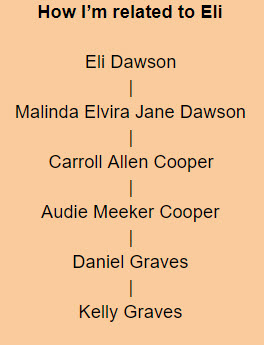
Eli was born in Kentucky in 1822, which made him 39 years old when he joined the militia; however, the militia unit was formed for one mission, and his term of service was short. On June 17, 1862, Eli enlisted in Cocke’s Regiment, another Confederate unit, but was discharged on July 21, 1862.v Confederate records are often vague, and his does not specify the reason for such an early discharge. There is no further record of Eli’s military service until February 5, 1864, when he enlisted in the 3rd Arkansas Volunteer Cavalry, a unit of the Union army.
In other words, he switched sides.
Eli was not the only Union soldier in the 3rd Arkansas with prior Confederate service. A comparison of names on the roster of the Company M, 3rd Arkansasvi (Eli’s company) with those in the Civil War Soldiers and Sailors System and the National Archivesvii found that 34 of the 105 men (32%) in Company M had prior Confederate service. Several of themviii were among the Peace Society members who were forced into Confederate service after being arrested and sent to Little Rock in 1861. At least a dozen more, Eli included, were part of the 45th Arkansas Militia that took them there.
How did these men happen to serve together? All I have is a theory. Actually, I have a couple of them.
By early 1864, the South had to know they were losing the war; their infrastructure was destroyed, their soldiers were starving, and they didn’t have the resources available to win. Maybe Eli and his neighbors recognized this and determined that their interests would be better served by finishing out the war on the winning side.
A less cynical and more noble explanation is that the men were trying to take their homeland back. The people of the Arkansas Ozarks were reluctant soldiers: as Russell P. Baker said, they just wanted to be left alone. However, the war came to them despite their reluctance to engage. There were few major battles or serious skirmishes in northern Arkansas, but the population was terrorized by bushwhackers, guerillas, and other bandits, who regularly robbed and assaulted residents and destroyed their crops and property. According to the Encyclopedia of Arkansas, the 3rd Arkansas was tasked with taking control of north-central Arkansas back from the marauders,ix and managed to do so fairly quickly. Service in this particular unit would have added legitimacy to the Peace Society’s stated goal of self-protection, allowed the soldiers to remain close to home and protect their property and families.
I don’t know much about Eli Dawson after his military service. Although some accounts show that he died in a military hospital, I haven’t found any evidence to support this. I do know that the men who returned home from the 3rd Arkansas – at least the ones I know about – were never the same.
But those are stories for another time.
Endnotes
[i] Arkansas Peace Society, CALS Encyclopedia of Arkansas, https://encyclopediaofarkansas.net/entries/arkansas-peace-society-2821/.
[ii] Baker, Russell P., “The Arkansas Peace Society of 1861,” Arkansas Historical Quarterly, Spring 1958, page 83.
[iii] Letter from Sam Leslie to Governor H.R. Rector, “Documents Related to the Arkansas Peace Society of 1861,” Arkansas Historical Quarterly, Vol. XVII, Spring, 1958, No. 1, page 82, edited by Ted Worley.
[iv] “Documents Related to the Arkansas Peace Society of 1861,” edited by Ted Worley.
[v] Compiled Service Records of Confederate Soldiers Who Served in Organizations from the State of Arkansas, The National Archives, Publication Number M317, Record Group 109, Roll 0244.
[vi] Posted at http://www.couchgenweb.com/civilwar/3cavcom.html.
[vii] The Civil War Soldiers and Sailors database may be accessed at https://www.nps.gov/civilwar/soldiers-and-sailors-database.htm. Military records from the National Archives are available at fold3.com, an online subscription database.
[viii] There were at least five: David Barnett, Thomas E Brown, William Potter, Benjamin Taylor, and Benjamin Watts.
[ix] “Third Arkansas Cavalry” (US), CALS Encyclopedia of Arkansas, https://encyclopediaofarkansas.net/entries/third-arkansas-cavalry-7398/, accessed 20 Jun 2019.
 Ordinary People