One of my favorite “I wonder if there’s any truth to it” family stories concerns my paternal great-grandfather Isaac Graves and Albert E. Brumley, the great gospel songwriter. The story goes like this: In the late 1920’s, Isaac’s son Clyde (my grandfather) attended music school with Albert Brumley. Brumley was working on a new song and had lyrics but couldn’t come up with the right melody. Isaac had written a melody that worked well with the lyrics, and he sold the melody to Brumley, who copyrighted the song. “I’ll Fly Away” went on to become the second most recorded gospel song of all time (behind “Amazing Grace”). Albert Brumley eventually became the best-known gospel songwriter in the country, and Isaac Graves walked away with $60.
Brumley’s inspiration for the song is well-documented: he was working in the cotton fields on the family’s eastern Oklahoma farm and humming “The Prisoner’s Song,” a tune about a convict who dreams of flying out of the prison walls to see his sweetheart, when he began visualizing the world as another kind of prison. This idea eventually became “I’ll Fly Away.”1 There is no clear explanation of how Brumley developed the melody for the song and, although he began writing “I’ll Fly Away” in 1928, it was not copyrighted until 1932.
So is the family legend true?
Albert Brumley and Clyde Graves both attended the Hartford Musical Institute at Hartford, Arkansas, although I haven’t found any evidence that they were there at the same time. The school was opened by E.M. Bartlett in 1921 and was sponsored by Bartlett’s music publishing business, The Hartford Publishing Company. The Hartford Publishing Company primarily printed songbooks, and since most people did not read music, the songbooks were written using the shape note method (in which each note on the scale is represented by a different shape) rather than conventional musical notations. Like many publishing companies at that time, Bartlett frequently sent teachers out to rural communities to teach music using shape notes, and sponsored singing conventions in cities and rural towns that would bring in singers (including music students) from the area. In the years before radio became mainstream in rural areas, making and listening to music was a large part of the lifestyle and identity of many families; the publishers capitalized on this by using schools and conventions as marketing tools to sell their songbooks.
E.M. Bartlett was Brumley’s mentor and hired him to travel to small towns and teach singing in the late 1920’s. Audie Cooper Graves, who married Clyde in 1930, reported that her family knew Bartlett well, and that his singing teachers would sometimes stay in the Cooper home when they were in the Braggs (Muskogee County), Oklahoma area.2 The Graves and Cooper families were neighbors and friends, and it’s possible that Isaac and Clyde Graves may have known Bartlett and/or Brumley through that association.
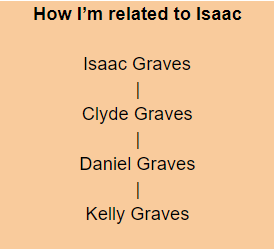
Isaac and his family had strong musical traditions of their own. He was born in Boone County, Arkansas in 1880 and moved to Oklahoma at the turn of the century. By the 1920’s he and his family lived in Braggs, where he taught singing in addition to running a restaurant and a butcher shop. Isaac was also a songwriter and musician who, in 1902, was the Arkansas five-string banjo champion. According to family lore, he stopped playing the banjo after he married in late 1902;3 however, he and his children continued to sing at music conventions in the area. My grandparents referred to the conventions as “All day singing and dinner on the ground.” Gospel music was a critical part of their lives.
This love of music was passed through the generations, and I heard family members sing and play the song for years before I ever heard the “I’ll Fly Away” story. I’ve been thinking a lot about whether to believe the legend, and there are a couple of things that I keep coming back to. The first is the story’s consistency and the nonchalance with which it’s told. With most family legends, the facts have a certain degree of fluidity; for example, if a descendant repeats a story about an ancestor who was a Cherokee princess (every family has one), another will likely say something like “I’ve been told that story too, but I heard she was Chickasaw.” With the Albert/Isaac story, I would expect that the songwriter or song or dollar amount would change with the telling, but it never does. In her own research notes, Ronna Lynn Barrett wrote that while working on the melody to “I’ll Fly Away,” Brumley “enlisted the help of some of his singing school friends. The family story is that Isaac sold him the melody for $60. Every family member we interviewed confirmed this story.”4 The story is typically told so casually and devoid of embellishment – as though the teller is describing the sale of a car or a horse – that it feels authentic.
But then there’s that $60. Adjusted for inflation, $60 in 1930 would be equivalent to about $876 today.5 In her biography, Hively describes Brumley as a “sharp businessman who could easily deal with the wheelers and dealers in the music world.”6 But Brumley was a part-time teacher, a singer who was paid $50 per month singing for the Hartford Music Company,7 and a songwriter who was typically paid not in cash, but in songbook copies. I have to question whether he would have paid such a large sum for the melody of a song that was unlikely to generate a profit and that he seemed to be in no particular hurry to finish.
Over the past almost-century, “I’ll Fly Away” has become bigger than its origins or the sum of its 150 or so words: between 2004 and 2009 alone, it generated $1.4 million in songwriting royalties.8 It’s a valuable piece of property and its ownership has been litigated more than once. But here’s my favorite thing about the song: I don’t think anyone in the Graves family cares about its ownership or provenance–it’s not our property. It’s just a good story and a great song, and that’s enough.
Some music you might enjoy:
The Prisoner’s Song: https://www.youtube.com/watch?v=BR9V7pZEY60
Two of my favorite versions of “I’ll Fly Away”:
- Staple Singers: https://www.youtube.com/watch?v=piNK5vu2Et0
- Alison Kraus/Gillian Welch: https://www.youtube.com/watch?v=uz-0C2dhKlg
Endnotes
1Hively, Kay and Brumley, Albert E. Jr., I’ll Fly Away: The Life Story of Albert E. Brumley,copyright 1990, Mountaineer Books, Branson, Missouri, p. 25.
2Ronna Lynn Graves Barrett genealogical research papers, in possession of Kelly Graves.
3Ibid.
4Ibid.
5Based on annual inflation of 3.06%, as valued on www.dollartimes.com, 30 Jun 2019.
6Hively and Brumley Jr., page 32.
7Hively and Brumley Jr., page 26.8Gee, Brandon, “‘I’ll Fly Away’ royalties lawsuit has big stakes: Family spat could provide guidance on copyright termination”, article in The Tennessean, 31 Jul 2011, https://www.theaquilareport.com/ill-fly-away-royalties-lawsuit-has-big-stakes-family-spat-could-provide-guidance-on-copyright-termination/, accessed 30 Jun 2019.
 Ordinary People