Many years ago I became lost with my brother Ken and cousin Eric while driving “the back way” from Ione, Oregon to Portland. We saw a sign pointing to Arlington, which we knew to be on Interstate 84, and took the turn down a two lane road that soon turned to one lane and then to dirt. We drove for quite a while, not knowing if the road we were on even had a name, but certain that we were going north toward the Columbia River, which would lead us home. Ken suddenly stopped the car and declared that he knew where we were. “We’re on the Oregon Trail!” he said, pointing west. And he was right–wagon ruts were clearly visible moving toward the hills in the distance.
One hundred twenty or so years earlier, in April 1865, Hugh Warren, my 3rd great uncle, loaded his family into a wagon and headed west from Missouri over the Oregon Trail, leading a wagon train that included 136 wagons and 1,500 head of cattle. The 1,600 mile journey took five months, and ended in Walla Walla County, Washington.[i]
I read somewhere that Hugh moved his family west after becoming disillusioned when his home was burned by bushwhackers in 1865. I don’t know if that’s true, but it certainly wasn’t his first journey out of the midwest. In 1860 Hugh was working as a day laborer in Napa, California[ii] while his wife and children remained in Sullivan County, Missouri[iii]. It’s possible he was lured west by the prospect of gold, or he may have just wanted to explore the opportunities offered by the rapid development of the western territories. Regardless, he was back in Missouri by 1863 and on the road again – this time with his wife and younger children – in 1865.
Hugh farmed and raised livestock in Walla Walla, and over the next few years several Sullivan County family members followed him to Washington Territory, including his son Henry and nephew Andrew. By the early 20th century, both men had settled in Morrow County, Oregon.
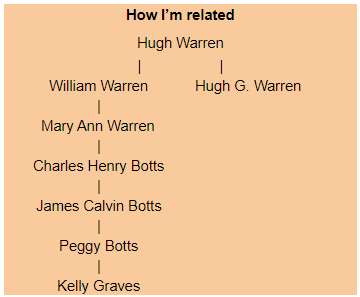
Around the same time that Andrew Warren was crossing the Columbia River to Oregon, his younger sister Mary Ann and her husband James Botts (My 2nd great-grandparents) went to western Oklahoma with their son Charley and his family, chasing the promise of cheap farmland after the federal government opened western Oklahoma reservation land to lottery in 1901. They homesteaded adjoining parcels of land in Woodward (now Ellis) County, combining the land into one large farm after James and Mary Ann died. However, in 1924 Charley declared that he wanted “to see more of the country;” he sold the farm, bought a 1923 REO Speedwagon, and drove most of his family west to Shelton, in western Washington[iv].
Shelton was an interesting choice. Charley was a wheat farmer, winning second place in the wheat exhibition in the 1921 Oklahoma state fair[v]. Sullivan County, Missouri, where Charley was born and raised, produced (and still produces) a lot of wheat, as does Ellis County, Oklahoma. Shelton and Mason County grow a lot of fruits and vegetables, but absolutely no wheat[vi]. Charlie wrote in 1924 that “I have found my heart’s desire of what a home should be. The land of sweet clover, honey bees, mountain trout, squirrels, and all kinds of fruit.”[vii] Despite this endorsement, Charlie apparently decided that he was not a honey and fruit guy, and the family remained in Shelton for only nine months. In 1925 they joined Andrew and Henry Warren in Morrow County, where, not surprisingly, they grow a lot of wheat. The family moved first to Gooseberry and later to Ione. Within a couple of years, all of Charlie’s children, including my grandparents, had joined them.
And that is why I’m an Oregonian.
My mother grew up very close to the Oregon Trail. Her father and most of his siblings were farmers without farms, drifting back and forth across the Columbia River to find work wherever they could. Despite their lack of stable income and home, they always seemed very settled in that landscape, with most of them living out their lives in eastern Oregon and Washington and many of them buried in the Ione cemetery. I don’t know that any of them ever gave the Trail any thought or realized that the old bottles and thimbles and coins they found as they moved through the fields were likely the detritus of the early pioneers.
I didn’t know any of that history when I stood
on a dirt road three decades ago and marveled at the wagon ruts that were still
visible after a century and a half of Eastern Oregon wind and rain, and the
nerve and passion of the people who were willing to risk everything to try
something new (even when it turned out it wasn’t that new after all). I just
knew that those journeys mattered. And I still don’t know if Hugh
Warren’s wagon contributed to those particular ruts, or if the junction where
he made a right turn into Washington Territory was somewhere on the Trail
behind me. I’m just profoundly grateful that he made the trip at all.
[i] Census of Overland Emigrant Documents, Document description for Felix Warren, www.paper-trail.org, accessed 5 Sep 2019.
[ii] 1860 U.S. Census, Yount, Napa, California, family 255, household of Robt N McIntire, enumerated 14 Jun 1860.
[iii] 1860 U.S. Census, Sullivan, Missouri, family 1502, household of Easter Warren, enumerated 8 Sep 1860.
[iv] Alice Botts Cooley, “Botts, Charles Henry,” Our Ellis County Heritage, 1885-1974, Ellis County Historical Society, 1974.
[v] “Local Wheat Wins at State Fair,” The Supply Republican, 13 Oct 1921, page XX, newspapers.com, accessed 19 July 2019.
[vi] USDA Census of Agriculture, 2017 Census, http://www.nass.usda.gov/publications/agcensus/2017/online-resources/county-profiles, accessed 5 Sep 2019.
[vii] “Letter From C.H. Botts,” The Supply Republican, 27 Nov 1924, page 1, newspapers.com, accessed 19 Jul 2019.
 Ordinary People