In 1934 my grandparents loaded up my father, who was an infant, and his older brother and left the dusty plains of Eastern Oklahoma for the hope of a better future in California.
Over a half century later I asked my grandfather about their journey. He told me about the children in the makeshift roadside camps forming an outer circle around the family’s campfire dinner, hoping for handouts. He described the frequent mechanical breakdowns and how, by the end of the trip, the car was held together with baling wire and prayers. And in the middle of all of it, he dropped this story:
The drought had got pretty bad by the time we decided to go to California. Lots of families were moving west, and the family that lived behind us, across the potato field, come by one night and said they was going to California and did we want to go with them? We told them we were waiting for some other family to come with us and we wasn’t ready to go yet. The truth was, their son Tom was trouble and your Grandma didn’t like the way he looked at her, so we didn’t want to go with them. Anyway, they left a couple days later, and on the way they met that fella Steinman who wrote that book about them.”
“Wait,” I said. “Do you mean John Steinbeck?”
“Yeah, that was the fella,” he replied.
“You lived across the potatoes from the JOADS????”
“Well,” he said, “that was their stage name. Hey Aud,” he called to my grandmother Audie, “what was the name of that family who wanted us to go to California with them? Jones? James?”
Grandma remembered that it was something like that, and she “just didn’t like that boy.”
It was a great story and I never forgot it.
The Grapes of Wrath was published in 1939, but Steinbeck’s research for the book really began in 1936, when he was hired to write a series of articles about dust bowl migrant farm workers for The San Francisco News.[i] The articles were eventually collected and published in book form as The Harvest Gypsies and, like the novel they inspired, are a stunning indictment of the inhumanity and greed of the corporate farm machine in California’s Central Valley in the 1930s, as well as the ugliness of bigotry and intolerance.
My father was too young to remember his family’s migrant experience in the Central Valley. He knew that they lived in a boxcar in Tulare and my grandfather worked in the cotton fields. That they were poor and were forced to buy most of their goods from an overpriced company store, resulting in most of my grandfather’s wages going back into the pocket of the people who paid them. The conversation detailed above was the only time I remember hearing my grandparents talk about that period. But I read The Grapes of Wrath and The Harvest Gypsies and understand that Grandad’s generosity of spirit and Grandma’s thriftiness likely grew out of their experience as migrants. They returned to Oklahoma at the end of the decade, when the drought ended, and didn’t return to California until nearly ten years later.
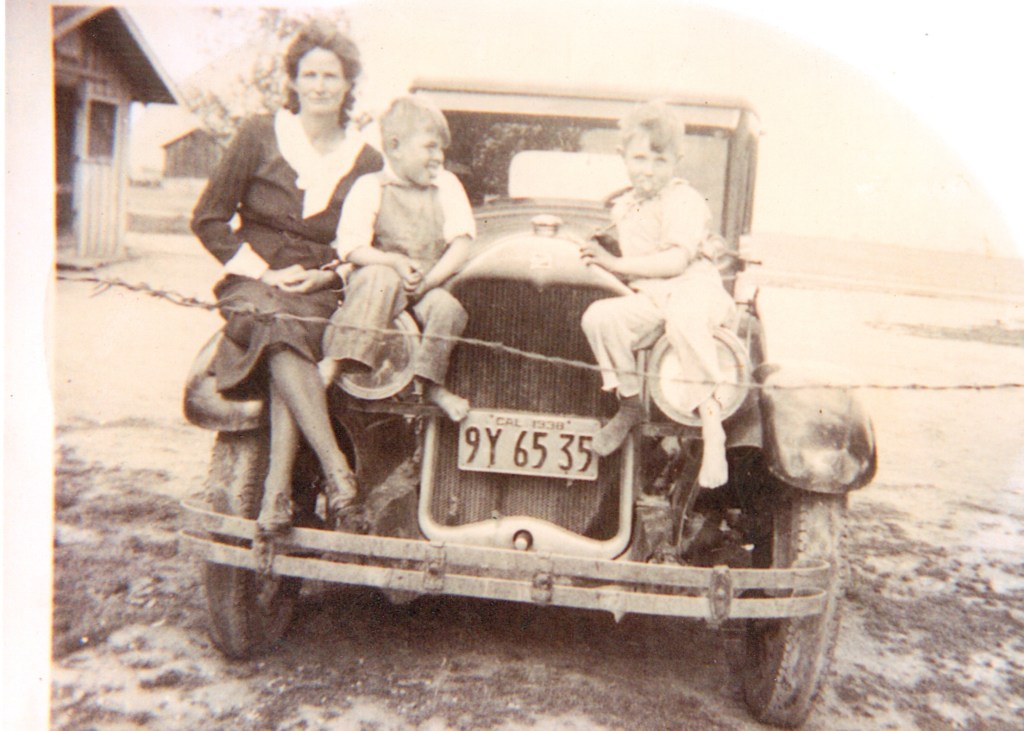
Now, I don’t believe for a second that my grandparents lived across the potato field from the family that inspired The Grapes of Wrath. The timing is all wrong—prior to 1936, Steinbeck was working on other projects—his novel Tortilla Flat was published in 1935 and he was already working on his next novel[ii]. And my grandfather acknowledged that he never saw or heard from the neighboring “Jones or James” family after their visit in 1934.
Nevertheless, I love this story and have often wondered if Grandad believed it was true. I recently sent a note to my father’s youngest brother and, after recounting the story, asked if he thought his father believed it. “If he said it,” he replied, “he probably believed it, unless he was pulling your leg . . . .”[iii] Grandad often did that. But it wouldn’t surprise me if he did believe it. The Grapes of Wrath tells a true story, even if the characters are fictional. If you were an Okie migrant in the 1930s, you likely either had firsthand knowledge of the hunger, frustration and fear experienced by the Joad family, or you knew someone who did. In Grandad’s case, the novel tells about an experience common to him and his neighbors. The fictional family’s name was similar to Grandad’s neighbors, and both had a son of dubious character named Tom. Steinbeck even included a character with my Grandad’s last name.[iv]
Assuming he did believe his own story, I don’t believe my Grandad was unique. I’ll bet there were a lot of Oklahoma migrant families with their own “I knew the Joads” story. It’s a badge, not in a “I was at Woodstock and was part of something really cool” sense, but as a way of telling their story without having to relive the nasty details.
I asked Grandad if Steinbeck’s book was accurate. “That’s exactly how it was,” he told me.
They were all the Joads.
[i] Charles Wollenberg, Introduction to The Harvest Gypsies, page v, 1988.
[ii] Wollenberg, page vi.
[iii] Message from D. Graves, 16 Oct 2019.
[iv] In the novel, the Joad family had a neighbor named Muley Graves.
 Ordinary People