Most of what I remember about the American Revolution from high school goes something like this: England colonized America and largely ignored it until, about a hundred years later, the king realized that America was thriving and would be a good source of revenue. In response to sudden and excessive taxation, America revolted and claimed independence. In 1775 Britain fought back, and the war began. I’m sure the actual causes were much more complex than my 9th grade textbook led me to believe, but at the heart of the rebellion was a desire for independence and fair and equal treatment.
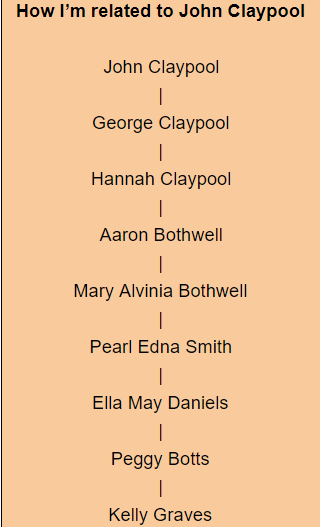
By 1781 the war was in its sixth year and money, supplies, soldiers, and morale were running low. In response, the Virginia Assembly imposed demands for higher taxes (82%!), provisions, and a draft to continue the war against the British. A group of men in the mountains of Hampshire County, Virginia (now Hardy County, West Virginia) opposed the resulting draft and high taxes; to them, these measures were no different than the laws and taxes imposed by the British. They elected a leader, John Claypool (my 6th great-grandfather), took up arms, and declared that they would not cooperate. The conflict ultimately became known as “Claypool’s Rebellion.”
In a letter to Governor Thomas Jefferson on April 14, 1781, Colonel Garret Vanmeter asked for help against the insurgents, explaining that
“A certain John Claypole said if all the men were of his mind, they would not make up any Cloathes, Beef or Men, and all that would join him should turn out. Upon which he got all the men present, to five or six and Got Liquor and Drank King George the third’s health and Damnation to Congress….”[i]
A warrant was issued for the rebels and 50 men were sent with the Sheriff to arrest them; however, upon arrival they were met by 60-70 armed men. No arrests were made and Claypool agreed to turn himself in. The agreed-upon time passed with no surrender, but a letter was sent to Colonel Vanmeter from one of Claypool’s followers, claiming that the majority of the insurgents regretted their actions, which were committed under the influence of liquor.[ii]
After a considerable amount of drama (but little bloodshed), Claypool and some of his co-conspirators were captured and held for trial, facing immediate execution if convicted. In order to quiet what was left of the rebellion, the State of Virginia offered pardons to the men – now rumored to number close to 1,000 – who had not yet been captured in exchange for their promises of fidelity to the new nation. Most of the men accepted. However, the offer was not extended to Claypool and the other jailed men.
John Claypool was a notable citizen in Hampshire County. He was a successful landowner, a leader in the community, and was related by blood or marriage to many of the prominent families in the county. He was considered an honorable man of principle. So it’s a little surprising what Claypool, now incarcerated, and four of his co-conspirators did next: they begged. Shamelessly. They used a “we’re just ignorant hillbillies” defense belied by the eloquence with which the plea was written:
That your petitioners living in an obscure and remote corner of the State, are precluded from every Intelligence of the State of affairs, either by Public Papers or from Information of Men of Credit and Veracity, and at the same time infested by the wicked Emmissaries or pretended Emmissaries of the British who travel through all parts of the Frontiers, and by Misrepresentations and false news poisoned the Minds of the Ignorant and credulous Settlers.[iii]
The petition went on to argue the unfairness of punishing men who “readily delivered themselves to Justice” while pardoning those who did not (it should be noted that Claypool did not “readily” deliver himself to justice–he surrendered after a five-day pursuit).[iv] The petition closed by stating that the men “humbly pray for Pardon, and that the Hon’ble Board will save their innocent wives and children from ruin and misery…” that will inevitably follow if the “deluded Husbands and Parents” face trial for their deeds.[v]
The Governor accepted the rebels’ explanation, and the five men were pardoned in February 1782. John Claypool returned to his farm, where he lived an otherwise uneventful life until his death in 1823. Whether he was truly repentant is a fact likely lost to history.
My feelings about John Claypool have evolved in the short time I’ve been working on this blog. What started as admiration for a badass who fought for what he believed in (I want to be like John) turned to shame because he gave up so easily (John is just like me), and ultimately settled at acceptance. His reasons for protest were good ones, but his capitulation was certainly understandable.
Today we’re able to make ideological decisions based on what has happened in the past. If I protest, it’s because I’ve seen how one action – like one woman’s refusal to give up a seat on a bus – can impact a movement that has the potential to change the country forever. John Claypool and his fellow protesters did not have the benefit of this insight. There was no American history in 1781. There was only his county and his farm and his family and a noble cause that he had no chance of winning and would likely result in his death if he pursued. When he was arrested in 1781, John was 48 years old and had 14 children. Nine of them were under 15 years old. Of course he begged for his life–being hanged for treason would not have been practical.
If we were to give it any serious thought, I believe most of us would hope that our ancestors were on the “right” side of history (the ones who operated far outside the norms of society make better stories, but we secretly hope that they’re distant cousins, not direct ancestors), as if decency is passed down through generations. John Claypool was a Tory who defiantly took up arms against the country and, when challenged, said “okay, never mind.” Looking at it from 2019, it seems cowardly and a little silly. But through a 1781 lens, he protested to protect his livelihood and capitulated to protect his family, and it all seems quite reasonable.
If you want to know more about the details of Claypool’s Rebellion, check out http://www.wvculture.org/history/revwar/claypool13.html
ENDNOTES
[i] Letter from Vanmeter to Jefferson, 14 April 1781, Documents from Calendar of Virginia State Papers, www.wvculture.org/history/revwar, accessed 16 Jul 2019.
[ii] Ibid.
[iii] The petition of John Claypole, Thos. Denton, David Roberts Jun’r, Mathias Wilkins, and George Wilkins, Documents from Calendar of Virginia State Papers, www.wvculture.org, accessed 16 Jul 2019.
[iv] “‘a dangerous insurrection has lately arisen in this County’: Claypool’s Rebellion in Hampshire County, Virginia, 1781”, The 2nd Virginia Regiment, www.secondvirginia.wordpress.com, accessed 15 Jul 2019.
[v] The petition of John Claypole, Thos. Denton, David Roberts Jun’r, Mathias Wilkins, and George Wilkins.
 Ordinary People
I was fascinated by the language–carefully chosen with an ear for audience–of the plea for pardon. The British are described in the margins of sentences with words like “wicked” and “infested” and “pretended,” and decisions are blamed on “false news.” Rings some contemporary bells, and I was reminded of the early women’s movement phrase “the personal is political.” Language has the power to shift arguments, and Claypool certainly used it to his advantage. He may have saved his life, as well as the lives of his family. An aside: I was shocked at the taxation that war demanded. How could a large family sustain itself on less than 20% of its earnings?
LikeLike
He is my 6th great grandfather as well. Thanks for sharing the story!! My family tree starts with his daughter Mary Jane marrying into the Metcalf family.
Beth V.
LikeLike
John Claypoole was my great (×9) uncle, and I love the perspective you gave on him. I too thought of him as cowardly, but I totally get it now. I have many other patriots in my family. Benjamin Wilson is one. He is my great (×) uncle, well known in the Shenandoah area during the Revolutionary war era…
LikeLike
I am Joe Claypool and the John Claypool in this blog is also on my family tree.
We are having a Claypool family reunion at Osage Beach, Missouri. Lake of the Ozarks. This year July 20 thru 24.
All are welcome!
Come join us.
ruby850i@hotmail.com
LikeLike